

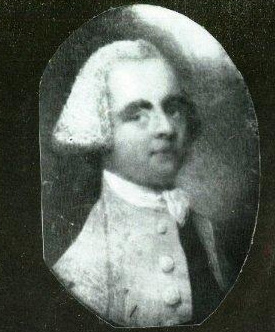
Samuel Jarvis married Naomi Brush of Cold springs, Long Island, and removed from Huntington to Norwalk in Connecticut, where he died on Sept. 27, 1779, at the age of 81 years [Editor’s note – Naomi was the daughter of Samuel Griffin and Elizabeth Platt b. 15 Sep 1665, Huntington, Suffolk, N.Y. d. 1740. Samuel Griffin died when Naomi was very young. Elizabeth remarried Mr. Brush and apparently Naomi took her stepfather’s surname]. He was commonly known as “Captain Samuel Jarvis” [Editor’s note: the origin of his rank is not known; it may have been his rank in the local train band – a colonial militia unit; but it is possible he was a seafaring man]. He had a family of 11 children of whom Samuel Jarvis, Jr., was the oldest. Three other sons claim a passing reference, viz.
- John (1725 -1778) who had three sons in the British Service in the War of the Revolution
- Stephen (1729 – 1820) of Danbury in Connecticut, whose son Colonel Stephen Jarvis (1756 – 1840) came to Fredericton, N.B., and, afterwards settled in 1809 in Toronto, where his descendants are numerous and highly-respected. Canon R. Jarvis being one
- Abraham Jarvis (1739 – 1766), who succeeded Bishop Samuel Seabury as the second Bishop of Connecticut
Captain Samuel Jarvis had a family of eleven children and his example was followed by two others of his descendants in our line of Jarvis ancestry, who will be mentioned presently.
Samuel Jarvis, Jr. (1720 – 1783 )
Samuel Jarvis, Jr., was born, Dec.r 28th, 1720 , and married Martha Seymour, Dec. 18, 1741, probably at Norwalk. About this time he removed to Stamford, perhaps a little later. The names of his children appear on the opposite page and the number is the same as that of his father, viz., eleven. An examination of the Family Register will show that in this family – comprising father, mother, and eleven children , each individual had only a single Christian name. it is still more remarkable that the 13 individuals of the family had only 10 Christian names among them. One child had the same name as the father, one the same name as the mother while the 7th and 11th both bore the name of Seymour. This last circumstance is explained by the fact that the older son Seymour was drowned while quite young, and the little son born a few months afterwards was given the same name. The longevity of this Jarvis too is remarkable, and is only exceeded in any line of our ancestry, as far as my knowledge extends, by the family of Silas Raymond in which the average of the children is 83 years.
Martha Seymour, the mother of the Jarvis family, whose names appear below, was married at the age of fifteen and had three children before she had attained the age of twenty-one.
— Jarvis Family Register (from a record left by Seymour Jarvis of Stamford, Connecticut)
Samuel Jarvis, b. Dec. 27, 1720, d. at New York, Sep1. 1, 1780, aged 60 yrs.
Martha Seymour, b. __1726, m. Dec. 18, 1741, d. at Stamford, Dec. 1, 1803, aged 77 yrs.
Their children were
- Munson, b. Oct. 11, 1742, died Oct. 7, 1825, at St. John, N.B. AE. 83 years
- Samuel, b. July 4, 1745, died Oct. 9, 1838, at Stamford, AE 94 years
- Polly, b. Feb. 21, 1747, died May, 1826, at Woodstock [N.B.], AE 80 years
- Martha, b. Dec. 27, 1748, died ___ 1784, at Halifax, AE 36 years
- Sarah, b. Nov. 28, 1750, died Aug. 14, 1807, at Stamford, AE 57 years
- John, b. Oct. 11, 1752, died Feb’y 1847, at Portland, N.B., AE 95 years
- Seymour, b. Sept. 20, 1754, died May 26, 1768, drowned at Stamford, AE 13 2/3 years
- William, b. Sept. 11, 1756, died Aug. 13, 1817, at York, U.C., AE 61 years
- Hannah, b. Sept 27, 1758, died Apr. 23, 1829, at New York, AE 71 years
- Levinia, b. Oct. 5, 1761, died Oct. 26, 1841, at Stamford, AE 81 years
- Seymour, b. Dec. 22, 1768, died Oct. 14, 1843, at Stamford, AE 75 years
Of the above, Polly Jarvis married Fyler Dibblee; Martha Jarvis married a Mr. King; Sarah Jarvis married Nathaniel Munday; Hannah Jarvis married Mr. Ingersoll; and Levinia [sic] married Rev. Ambrose Todd, Sen., the Rector of Stamford in succession to Dr. [Ebenezer] Dibblee.
Samuel Jarvis, the father of this family, was an active Loyalist and a zealous member of the Episcopal Church. According to Canon Jarvis of Toronto, Samuel Jarvis of Stamford died in New York Feb. 25, 1783, and was interred in Trinity Churchyard – the date given by the Stamford local historian in his book, however, is September 1, 1780 . His son William was a U.E. Loyalist, a Cornet in the Queen’s Rangers and the first Provincial Secretary of Upper Canada. From him the Jarvises of Hamilton and Ottawa and AEmilius Jarvis of Toronto trace their descent.
The local historian of Stamford in his book published some sixty years ago, of which my copy is in the Fisher Memorial Public Library in Woodstock, has very interesting information concerning the Jarvis family. We learn from its pages that Samuel Jarvis of Stamford bought of Nathaniel Finch, on January 11, 1744, a dwelling-house, home-lot, farm and shop. Samuel Jarvis was born in 1720 and was a useful and contented citizen of the little Connecticut town until the Revolutionary troubles, about 1775, threw everything into confusion, and compelled him as a Loyalist to seek protection within the British lines at New York.
He was, in 1757, one of the Wardens of Stamford of the Parish of which the Rev. Dr. Ebenezer Dibblee was rector for over half a century. In addition to his active interest, and that of family, in the Episcopal Church, he was the Town Clerk of Stamford. The author of the Stamford history states (p. 214 of his book): “The Jarvis family were excellent and prominent people here, but their affections were with the King rather than with his rebellious subjects.” In other words, they were thorough-going Loyalists.
A special town meeting was held at Stamford in March, 1774, at which Capt. Fyler Dibblee and Dr. John Wilson were appointed to attend a meeting at Middletown, Connecticut, on the 27th of March, at which a petition was agreed upon and signed by Samuel Jarvis in the name of the Town of Stamford, he being town-clerk, and ordered to be forwarded to the Assembly at its next session. “The petition referred to,” says the Stamford historian, “was couched in terms of excessive loyalty to the English Government; but within a year the majority of the people seem to have espoused the cause of the revolution.”
Samuel Jarvis continued as town-clerk as late at least as Sept. 19, 1775. But on April 3, 1776, his son Munson and David Pickett were tried by the “rebels.” On being summoned before the Committee of Inspection they were charged with having signed a paper pledging themselves “to assist the King and his vile minions in their wicked, oppressive schemes to enslave the American colonies,” and with endeavouring to discourage military preparations to fight against the British, and also with trying to dissuade persons from acknowledging the authority of the Congress. They acknowledged their signatures on the paper were pronounced guilty of a great crime. The Committee voted to advertise them as “enemies of their country” and they thus conclude their sentence: “And we hereby recommend it to all persons to break off all commerce and dealing with them, and to treat them agreeably to the resolves of for those who are deemed enemies of their country.”
We learn further from the statement of David Pickett before the Commissioners on Loyalist Claims at St. John, N.B., on February 2, 1787, that he left Stamford in September, 1776, and joined the British on Long Island. He had already been advertised as an enemy of his country, after a trial by a committee, in consequence of having signed a paper to manifest his loyalty. This was the reason of his quitting home. His wife was “turned off” [i..e, evicted from her property] eleven days after he went away.
Isaac Bell on being called to substantiate Mr. Pickett’s evidence, says that he remembers Pickett’s being advertised as an enemy to the state. Bell was obliged to assist the family privately and was a witness to Mrs. Pickett being turned off the premises when their effects were seized. He says that “Mr. Pickett was an honest, good man”, who from the first declared his loyalty and suffered as much as anyone. He was a weaver and carried on a good deal of business. He had two or three looms going.j
About the time Munson Jarvis, Fyler Dibblee and David Pickett were banished, and their property confiscated – or a very little later – Samuel Jarvis was similarly treated.
The Stamford historian adds that “When it seemed necessary that the Jarvis family should be sent over the line, Capt. Samuel Lockwood of Greenwich was appointed to execute the order, which he did with the ready zeal of a Revolutionary Patriot, and of course his officiousness alienated the two families, though afterwards a grandson of Lockwood’s married a granddaughter of Samuel Jarvis.”
Samuel Jarvis was transported to Long Island but removed from thence to New York, where he found an asylum from the vengeance of his countrymen. He died there on September 1st , 1780.
We shall speak of those of the family who came to New Brunswick at the close of the war. The eldest son, Munson, was one of these. He was born in 1742, at which time his mother was only sixteen and his father twenty-one years of age. Munson, with his brothers, John and William, and sister Polly (the wife of Fyler Dibblee) all came to St. John in 1783, I believe.
Munson was a grantee of Parr-town and took an active part there in civic, political and ecclesiastical matters. At the organization of the City of St. John on May 18, 1785, he was a member of the first City Council, and from 1803 to 1810 one of the Representatives from the City and County of St. John in the Legislature of the Province. At the opening of Trinity Church in 1791, he was one of the Vestry and afterwards, and for many years, a churchwarden. He established a hardware business on the South Market Wharf, which he carried on successfully for more than forty years in conjunction with his sons Ralph M. and William under the firm name of “Munson Jarvis & Co.”. Another of his sons, Edward James Jarvis, was afterwards the Chief Justice of Prince Edward Island. Munson Jarvis died in St. John at the age of 83 years. His brother, John Jarvis, lived for a time in the Parish of Kingston where he had a pew in the Church in 1810. He returned later to St. John and died at Portland (now St. John, North) in 1847, at the patriarchal age of 95 years.
It may be observed in this connection that the fifth child of the Stamford Jarvis Family, Sarah, married Nathaniel Munday. Her sister Polly Dibblee named her own fifth child “Sarah Munday”, and she afterwards married John D. Beardsley of Woodstock (in 1793) and is spoken of by her descendants as “Sally Munday Beardsley”. She seems to have been a true Jarvis, for she too was the mother of eleven children, six sons and five daughters. The oldest of these was my Grandmother Raymond, Polly Sylvia, who was so called after her two grandmothers Polly Jarvis and Sylvia Punderson.
This surely is a “Chapter on Names.” The circumstances under which Fyler Dibblee and his wife Polly came to New Brunswick in 1783 have already been related in this book [Editor’s note – the Dibblee family saga will be told in another series. Briefly, Fyler and Polly went to New Brunswick in 1783. He had been a successful Stamford lawyer, but lost everything in the War, and the Dibblee family then suffered a series of calamities; Fyler took his own life in 1784 leaving his widow and children in straitened circumstances].
The rather forlorn situation of the family after death of Fyler Dibblee is spoken of by Munson Jarvis in his letter of Aug. 5th, 1788, to his brother William, who was then in London, England. He writes:
“I have not received about sixty guineas of what Brother Dibblee owed me when he died, and what I have given them since, which together in full is much more. Sister Dibblee is now about going to Stamford with her two youngest children [who were Sally Munday, aged 13, and Ebenzer, aged 8 years]. Bedell, William, and Ralph have taken land at Meductuck, 130 or 140 miles up the River, where they say the lands are much better than where they are now; but I fear they are but poor farmers. William is a very hard-working man; believe Ralph will work if he can’t help it. Walter seems entirely detached from the family, taking shelter under the wing of his father-in-law Mr. Beardsley, who I believe is full as good a farmer as a Preacher.”
If Mrs. Dibblee really ever went to Stamford with her children, she must have soon returned and gone up the River to Woodstock to live with her son William. The settlement there seems to have been still spoken of by the Indian name “Medoctec” (or Maductic), so called from the waterfall — nearly 100 feet in height. It is the highest fall in the St. John River System.
William Munson Jarvis, who is now (1920) living in St. John, N.B. at the age of about 85 years, was a grandson of Munson Jarvis the Loyalist. He was for many years active in Church affairs, particularly in the old “Diocesan Church Society,” and in the “Diocesan Synod,” which he did more than other layman to create. He was also very active at different times as a layman in the parishes St. Paul and St. Mark in St. john. Also in Religious Educating and in Church matters in general.